MOTS-c: running mice and human blood samples
Better mouse performance and a blood marker in dialysis patients describe very different relationships with the same peptide.
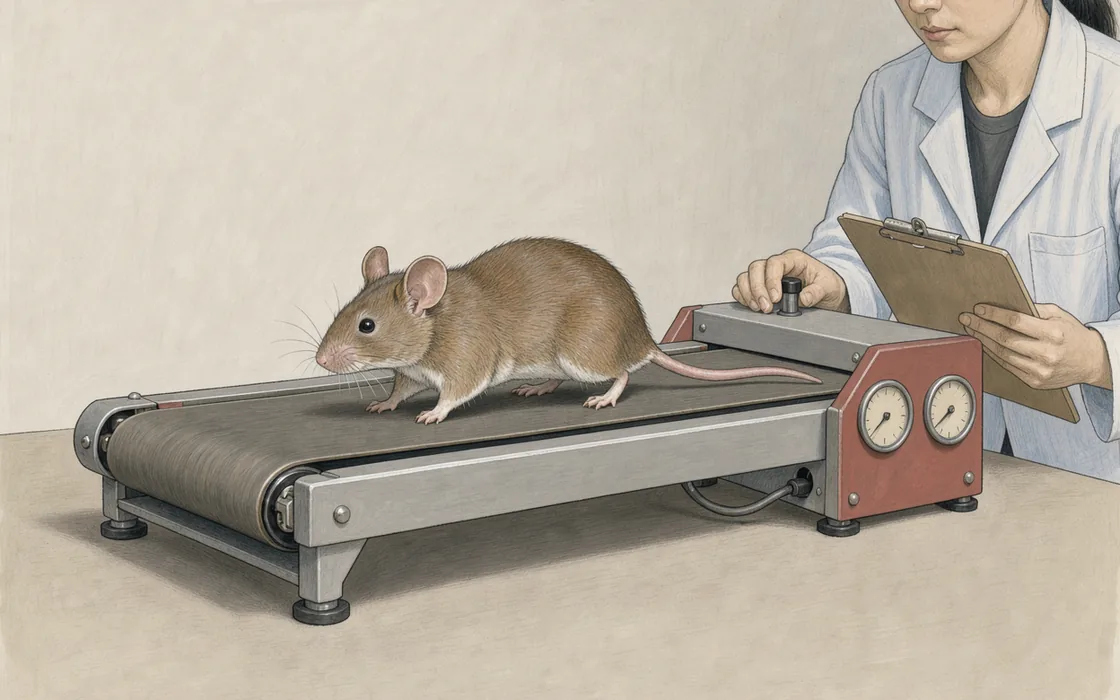
Mouse treadmill tests
The 2021 exercise study examined MOTS-c and physical performance in mice. Exercise increased the peptide naturally present in muscle and circulation; giving extra MOTS-c improved performance in young, middle-aged and old mice, including running capacity, grip strength and gait in aged animals.
The phrase “exercise mimetic” makes a very tempting shorthand. It is an experiment about physical capacity, with outcomes that are easier to picture than a list of molecular signals. The human claim still awaits a controlled trial giving MOTS-c to people and measuring benefit and harm. These animal results establish neither a replacement for exercise nor a treatment for human aging.
The difference between the peptide already made in the body and extra peptide given experimentally matters throughout this story.
Mitochondrial origins
MOTS-c has 16 amino acids and is encoded within the mitochondrial 12S ribosomal RNA region. Mitochondria are the energy-producing structures inside cells and carry their own DNA. The 2023 review of MOTS-c biology brings together its origins, fuel-use effects and responses to metabolic stress.
In cell and animal research, inhibition of the folate cycle and new purine production leads to accumulation of AICAR, which activates the energy-sensing protein AMPK. Muscle glucose handling changes downstream. Under metabolic stress, MOTS-c moves into the nucleus and alters gene expression, including protective antioxidant-response genes. This is stress within cells struggling to meet energy demands.
I could happily spend longer on that journey from mitochondria to nucleus. It gives the biology a surprising direction: instructions from one compartment can affect another. The cell experiments answer a question about communication within cells; their relevance to giving extra MOTS-c to a person remains to be tested.
The CK2 experiment
The direct-binding experiments in 2024 identified casein kinase 2 as a target. The work included cell-free assays and mice that were young, aged, fed a high-fat diet or immobilized. MOTS-c activated CK2 in muscle and suppressed it in fat, with enhanced muscle glucose uptake and prevention of muscle atrophy in the experimental models.
The tissue difference is more interesting than the loose claim of “better metabolism.” An enzyme can respond differently in muscle and fat. The experiment narrows the mechanism while leaving the human treatment question open.
Dialysis observations
The multicentre human cohort involved 94 people receiving chronic hemodialysis, treatment that filters blood after kidney failure. Circulating MOTS-c was associated with a combined outcome of death or nonfatal cardiovascular events and improved the study’s risk-prediction model. The investigators measured endogenous MOTS-c; they did not treat the patients with it.
I would never infer from this association that adding MOTS-c improves a patient’s outcome. A substance measured in the blood may track an illness process. Establishing a beneficial intervention requires a different experiment.
Human safety and approval
Completed human trials have not established benefit from administered MOTS-c, and the evidence discussed here supplies no measured human half-life, bioavailability or dose-response. Mouse amounts and experimental timing provide no validated human regimen. Some findings also rest on small samples or a single laboratory and await replication.
The sources describe an inherited MOTS-c variant associated with diabetes risk and ancestry-dependent exercise responses. Those observations concern biological differences; the information here cannot predict an individual response to extra peptide.
FDA has not approved MOTS-c for human use. Research material lacks prescription-medicine checks on identity, purity and sterility. WADA and USADA prohibit its use in sport, with restrictions applying during and outside competition. Human side-effect uncertainty remains substantial even when the mouse experiments look encouraging.
The AOD-9604 trials show an animal result reaching a failed human endpoint. Tesamorelin supplies a different example: a demonstrated human effect with a narrowly defined approved use. Neither history settles the next experiment for MOTS-c.